BLOCK B
INTERVIEW WITH GRADE 10 FRENCH TEACHER, MS. CHEN AND HER OPINIONS ON THE SUBJECT


French teacher was given a few questions on a interview to answer what she enjoys and finds interesting about the subjects. The information given is recorded below.
The first question asked was "what career opportunities can students expect to get by taking French?" so future students and others who were interested would get a better understanding of what benefits they would receive.
"You can expect to get many government jobs--" she answered, "such as working as a translator in the healthcare field, in engineering, environmentalism, and public transit-" to which she further elaborated to "air ports, and the post office, just to name a few."
She was then asked "what does a usual lesson on French look like in your class?" to which she said "First-- we have a small lesson on grammar content at the beginning of class, then we focus more on general class activities-" to which she added, "such as a timed event where students can only speak French and using specific themes." "I will also sometimes provide worksheets for the class so I can be available to help them if any help is needed."
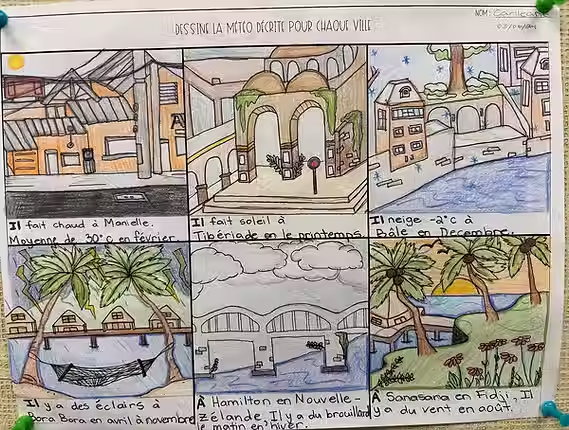
Following those questions, the interviewer asked what she thinks is the most interesting part about French. Although having a difficult time to answer, she eventually responded with, "I think its interesting being exposed to a whole new culture that is also a part of Canada's culture." "It's also fun to have the ability to master a completely new language with a new set of grammar rules, and different pronunciation than what you can expect in the English language."
"What do your students struggle most with? What do they understand easily?" "Most-- if not all, struggle with grammar since it is very different from English and since grammar is so prevalent, if you mess it up it becomes pretty obvious," she said, then answering the next question of the two, "vocabulary is usually decent- I'd say, especially if the words are similar to that of English words. Adding on, "certain verb tenses and future tense that connect to English are also more easily understood."
To add onto any who struggle with learning, the next question asked was if there were "any French learning techniques you recommend students take? If there are, what are they? And how effective is each technique for your students?
To which she answered, "What I recommend for my students is for them to take time to engage with French content outside of class for at least thirty minutes."
It was then mentioned she recommends, "watching a variety of French dubbed or subbed movies, TV shows, using Duolingo, read French books and listen to French songs." She then adds that, "Duolingo is especially effective- at least for me- since it provides daily reminders, allows you to join lessons with friends, and is very easily accessible as long as you have internet."
One interesting fact about this subject is that French was one of the few languages that made it to North America whilst originating in a country thats from a different continent- so asking Ms. Chen for her input, "Why does Canada speak both English and French? Why isn't French widely spoken in other places besides Europe and Canada?"
She answered, "--historical colonizers- both English and French settlers came to Canada, and although French came first, English eventually won the most control." "English is also just a language that became prevalent all over the world- French is also spoken in parts of Africa too. Wherever the French settlers really went, they had spread their language around so it makes sense countries like Canada have French as such a prevalent theme as it is just like English."
This concludes the end of the interview. Hopefully it was able to help any students currently enrolled, any students considering taking French, and any students who were curious about French.
FRENCH ARTICLE 1
